
 Excellent
KM MW Mineral Wool
SGBP-certified, non-combustible thermal and acoustic insulation for buildings and building services
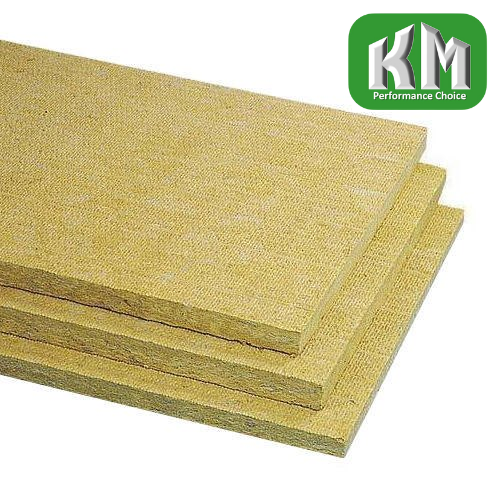
Semi-rigid stone-based mineral wool slabs, spun with RCS technology and bonded with a water-repellent thermosetting resin. Available in 64, 80, 100 and 120 kg/m³, plain or FSK foil-faced.
- SGBP
- Green Building Product, rated Excellent
- Non-combustible
- BS 476 Part 4, certified by TÜV SÜD PSB
- λ 0.034
- W/m·K at 20 °C, all densities
Collect products in your enquiry list and send them together for a quotation.
Verify on the SGBC Product Directory
Singapore Green Building Product
SGBP certified across the range
KM MW Mineral Wool is certified by the Singapore Green Building Council under the Singapore Green Building Product scheme, in the Thermal Insulation – Stone Wool category. Certified products help projects earn points under Green Mark.
Valid through 1 Sep 2028 View certificate 80kg/m³ Very Good SGBP 3598/3 · 50–100 mm
Valid through 1 Sep 2028 View certificate 120kg/m³ Excellent SGBP 3598/4 · 50–100 mm
Valid through 1 Sep 2028 View certificate
Also certified: Non-combustible to BS 476 Part 4 · TÜV SÜD PSB Certificate of Conformity CLS2 080498 0019, 63–125 kg/m³, valid until 8 May 2027View certificate
Overview
KM MW Mineral Wool is a medium-weight, stone-based mineral fibre insulation board for thermal reduction, acoustic control and fire protection in buildings. It is made with KM's exclusive RCS (Rapid Centrifugal Spinning) technology, which produces a very thin, even fibre structure bonded by thermosetting resins and water repellent. A Pendulum System then lays the fibres in thinner, more even air layers that block heat flow.
Made partly from recycled by-products of mineral extraction, it emits virtually no formaldehyde or VOCs. The semi-rigid boards are supplied for applications where a stiffer product is preferred, and form easily around the equipment being insulated.
Green-certified
SGBP Excellent at 64 and 120 kg/m³, with zero HCHO, TVOC, ODP and GWP.
Fire protection
Non-combustible to BS 476 Part 4, certified by TÜV SÜD PSB.
Thermal insulation
0.034 W/m·K at 20 °C cuts heat gain through roofs, walls and ducts.
Acoustic control
NRC up to 1.10. Adds 3–5 dB to stud-wall and floor sound insulation.
Specifications
- Material
- Stone-based mineral fibreBonded with thermosetting resin and water repellent
- Manufacturing
- RCS (Rapid Centrifugal Spinning)With Pendulum System fibre layering
- Form
- Semi-rigid board
- Nominal density
- 64 · 80 · 100 · 120 kg/m³4.00 · 4.99 · 6.25 · 8.00 lb/ft³
- Thermal conductivity at 20 °C
- 0.034 W/m·KAll four densities
- Fire performance
- Non-combustibleBS 476 Part 4:1970 · TÜV SÜD PSB CoC CLS2 080498 0019
- Green certification
- SGBP, Singapore Green Building CouncilExcellent: 64 and 120 kg/m³ · Very Good: 80 kg/m³
- Moisture resistance
- < 0.01% by volume< 0.1% after 4 days at 50 °C, 95% RH
- Max. service temperature
- 200–649 °C continuous300–1,000 °C intermittent · depends on density
- Corrosion resistance
- ASTM C795Chemically stable against acids, alkalis and weathering
- Standards
- BS 4958 Part 5 · ASTM C612Can be used to satisfy BS 5422 for pipes, ductwork and equipment
- Emissions
- Zero HCHO and TVOCZero ODP and GWP · asbestos-free
Maximum service temperature
Upper limits at the highest density. Lower densities are rated from 200 °C continuous and 300 °C intermittent.
Zero-emission formulation
- Zero HCHO
- Zero TVOC
- Zero ODP
- Zero GWP
- Asbestos-free
- Recycled content
Singapore Green Building Product · SGBC Excellent
Performance data
Nominal values from the KM MW technical data sheet (Rev. 07-2026). Specific designs should be evaluated in their end-use configuration.
Thermal conductivity by mean temperature
W/m·K. Denser slabs hold a lower conductivity at higher temperatures.
| Mean temp. | 64 kg/m³ | 100 kg/m³ | 128 kg/m³ | 160 kg/m³ |
|---|---|---|---|---|
| 25 °C | 0.034 | 0.034 | 0.034 | 0.034 |
| 50 °C | 0.040 | 0.038 | 0.037 | 0.037 |
| 100 °C | 0.050 | 0.046 | 0.044 | 0.044 |
| 150 °C | 0.060 | 0.055 | 0.052 | 0.050 |
| 200 °C | 0.073 | 0.064 | 0.060 | 0.057 |
| 250 °C | 0.086 | 0.075 | 0.068 | 0.065 |
| 300 °C | 0.102 | 0.086 | 0.078 | 0.073 |
| 350 °C | 0.121 | 0.099 | 0.088 | 0.081 |
Apparent thermal conductivity determined in accordance with ASTM C1045, with data obtained by ASTM C177. Values are nominal, subject to normal testing and manufacturing tolerances.
Sound absorption coefficients
Interconnected microscopic pores convert sound energy into friction.
| Thickness | 125 Hz | 250 | 500 | 1000 | 2000 | 4000 | NRC |
|---|---|---|---|---|---|---|---|
| 64 kg/m³ | |||||||
| 25 mm | 0.13 | 0.48 | 1.02 | 1.08 | 1.02 | 1.01 | 0.90 |
| 50 mm | 0.20 | 0.61 | 1.07 | 1.06 | 1.04 | 1.07 | 0.95 |
| 75 mm | 0.43 | 0.64 | 1.08 | 1.08 | 1.04 | 1.07 | 0.95 |
| 100 mm | 0.88 | 1.14 | 1.17 | 1.08 | 1.06 | 1.10 | 1.10 |
| 150 mm | 1.32 | 1.14 | 1.11 | 1.09 | 1.06 | 1.07 | 1.10 |
| 100 kg/m³ | |||||||
| 25 mm | 0.18 | 0.62 | 1.08 | 1.08 | 1.03 | 1.07 | 0.95 |
| 50 mm | 0.25 | 0.85 | 1.15 | 1.10 | 1.04 | 1.06 | 1.05 |
| 75 mm | 0.80 | 1.07 | 1.11 | 0.99 | 0.98 | 0.96 | 1.05 |
| 100 mm | 0.99 | 1.01 | 1.10 | 1.03 | 1.03 | 1.05 | 1.05 |
| 120 kg/m³ | |||||||
| 25 mm | 0.13 | 0.64 | 1.08 | 1.08 | 1.04 | 1.07 | 0.95 |
| 75 mm | 0.32 | 0.90 | 1.11 | 1.07 | 1.01 | 1.05 | 1.00 |
| 100 mm | 1.11 | 0.91 | 1.07 | 1.03 | 1.06 | 1.07 | 1.00 |
Design approximations only; production and test variability will alter results. Tested to ASTM C423, Mounting A (material placed against a solid backing).
Key features and benefits
- Singapore Green Building Product — SGBP Excellent
- Non-combustible — BS 476 Part 4
- Low thermal conductivity — 0.034 W/m·K
- High sound absorption — NRC up to 1.10
- Performance not affected by moisture contact
- Lightweight and highly durable
- Forms easily to the shape of equipment
- Fungi and vermin resistant
- Resists acids, alkalis and weathering — ASTM C795
- Made with recycled materials
- Zero HCHO, TVOC, ODP and GWP — asbestos-free
- Cost-effective thermal insulation
Recommended applications
Metal deck roofing
Thermal insulation and rain-noise reduction
ACMV systems
Thermal and acoustic insulation
Partitions and cavity walls
Sound insulation and fire separation
Façades and spandrel panels
Insulation behind the building skin
Concrete soffits and external walls
Thermal barrier to the building envelope
Plant rooms and machinery enclosures
Sound-absorbent lining
Floating floors
Resilient layer that absorbs impact noise
Fire protection systems
Non-combustible infill and barrier
Sizes, installation and storage
Densities and packaging
- Densities: 64, 80, 100 and 120 kg/m³
- SGBP-certified thickness: 50–100 mm
- Wide range of other thicknesses and densities available
- Shrink-wrapped in polyethylene; other sizes to order, subject to minimum order quantity
Available facings
- Plain (standard)
- FSK (foil scrim kraft) aluminium foil laminate
- Unfaced boards can be finished with reinforced silver foil, metal lath or wire mesh
- Then finished with insulating cement, canvassed and painted where required
Installation
- Fix directly to heated flat and curved surfaces with welded pins or studs
- Pins at 400 mm max spacing, within 100 mm of edges
- Above 204 °C, use a double layer; single or multiple layers up to 649 °C
- On faced boards, cover pins with matching vapour-sealing patches; use faced insulation on the outer layer only
Storage and handling
- Keep in original packaging until use and protect from rain
- Unpack at the application site to limit handling
- Work with good ventilation; wear gloves and eye protection
- Vacuum dust and offcuts. Do not use compressed air
Downloads
Frequently asked questions
Is KM MW Mineral Wool a certified green building product?
Yes. KM MW Mineral Wool holds Singapore Green Building Product (SGBP) certification from SGBC: 64 kg/m³ and 120 kg/m³ are rated Excellent (3 ticks) and 80 kg/m³ is rated Very Good (2 ticks), for 50–100 mm thickness. The certificates (SGBP 3598/2, 3598/3 and 3598/4) are valid through 1 September 2028.
Is KM MW Mineral Wool non-combustible?
Yes. It is non-combustible when tested to BS 476 Part 4:1970. This is certified by TÜV SÜD PSB under Certificate of Conformity CLS2 080498 0019 for densities from 63 to 125 kg/m³, valid until 8 May 2027.
Which densities are available?
KM MW Mineral Wool is available in 64, 80, 100 and 120 kg/m³. All four have a thermal conductivity of 0.034 W/m·K at 20 °C. Other densities and thicknesses can be supplied to order.
What is the maximum service temperature?
Depending on density, the continuous safe operating temperature is 200 °C to 649 °C, and the intermittent temperature is 300 °C to 1,000 °C. Single or multiple layers can be installed at temperatures up to 649 °C.
How well does it absorb sound?
NRC values range from 0.90 to 1.10 depending on density and thickness, tested to ASTM C423. In a stud wall or between floors it adds 3 to 5 dB of sound insulation, and under roof constructions it reduces reverberant noise by up to 10 dB.
Does moisture affect its performance?
No. Moisture absorption is less than 0.01% by volume, and after four days at 50 °C and 95% relative humidity it absorbs less than 0.1% by volume. If the insulation becomes wet, full thermal efficiency is restored once it dries out.
What facings are available?
KM MW is supplied plain as standard, or laminated with FSK (foil scrim kraft) aluminium foil. Unfaced slabs can be finished on site with reinforced silver foil, metal lath or wire mesh.
Specifying green-certified insulation?
Tell us the application, thickness and facing you need, and our team will help you choose the right KM MW density and supply the SGBP documents for your submission.